Strengthening the National Defense System to Support Regional Leadership
News & Article Saturday, 18 April 2026, 17:00
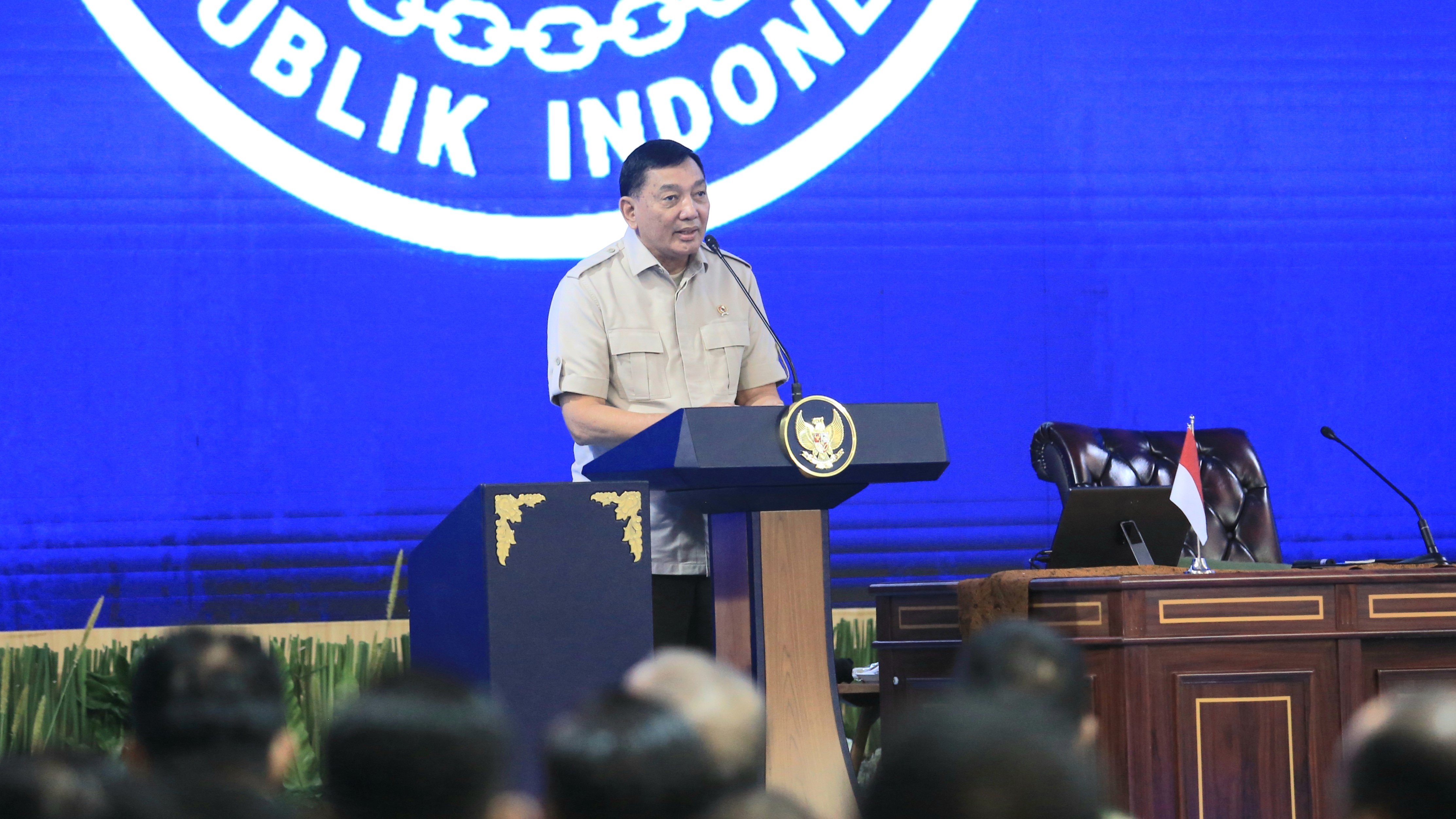
On Saturday (4/18), the Regional Leadership Strengthening Course (KPPD) for Chairpersons of Regional Representative Councils (DPRD) from across Indonesia featured a lecture by Indonesian Minister of Defense Sjafrie Sjamsoeddin on the national defense system. The course was held at the Military Academy (Akmil) in Magelang.
During his speech, Minister Sjamsoeddin explained that the defense system of the Unitary State of the Republic of Indonesia has four major dimensions. The first is the mobilization of national defense forces, led directly by the President as Head of State and Commander of the Indonesian National Armed Forces (TNI). The second dimension is the development of defense forces, the responsibility for which lies with the Minister of Defense in formulating national defense policy.
The third dimension involves the TNI Commander’s implementation of these policies. The fourth dimension involves the development of forces by each military branch: the Army, Navy, and Air Force.
However, Sjafrie explained that, in line with Article 30 of the 1945 Constitution, Indonesia adheres to the Universal People’s Defense and Security System (Sishankamrata). While the Indonesian National Armed Forces (TNI) and the Indonesian National Police serve as the primary forces, the system also stipulates that national defense involves all citizens as supporting forces.
“Establishing a strong defense is not the exclusive duty of the Indonesian National Armed Forces, but rather a shared responsibility of all citizens of the Unitary State of the Republic of Indonesia. We refer to this as Sishankamrata,” Sjafrie Sjamsoeddin explained.
Furthermore, Sjafrie reminded us that the Indonesian people are united in their dedication to the state, as reflected in the constitution and national interests. These two elements form the basis for establishing the national defense system.
Additionally, Sjafrie noted that Indonesia’s defense strategy is one of active defense. This strategy focuses solely on territorial protection and harbors no desire to attack other nations. Rather, it helps maintain global stability and peace.
He also described the National Safety Belt framework, which enables central and local governments, from provincial to regency/city levels, to carry out their duties with confidence and focus.
One example of this framework in action is the Territorial Development Infantry Battalions, which are deployed across various regions. These battalions work with all local authorities to maintain security and also play a role in strengthening the social environment, education, and the local economy.
In closing his presentation, Sjafrie emphasized that the Indonesian National Armed Forces (TNI) is committed to serving the nation’s interests as part of the people.
“We serve only the people. We come from the people, and we will return to the people. Our duty is to repay the people’s service to the state and the nation,” he stated. (ZA/MA/DA)